In June 2019, we launched the ‘CRaFT’ project, bringing together City of London Archaeological Society (COLAS) and TDP volunteers to study the causeways, riverstairs and ferry terminals on the Thames – these ‘CRaFT’ were an essential part of daily life, serving many functions. They helped you collect water, do your laundry, wash yourself, or water your horses. There were also many trades – such as fishing or shipbuilding – for whom the foreshore was their workplace and they also required safe access to the river; and it was here on the waterfront that products brought up to the City by boat could be bought or bartered, especially important in the 10th-12th centuries, for example, when regular beach-markets took place on the open foreshore.
Above all, riverstairs were the recognized landing-places from which to board, or alight from, a wherry (a form of river taxi) for short journeys across the river, or longer ones along it, for example to Gravesend in the east, or to Windsor in the west. These wherries were of particular importance in the centuries before buses and railways, and when just one bridge crossed the river between the Thames estuary and Kingston.
Between Vauxhall and Greenwich, over 200 CRAFT are recorded in documents or on old maps, and of these around seventy-five still survive in some form or other and our CRAFT volunteers have already surveyed close to thirty examples. (That means there’s almost another fifty to go).
Here’s a virtual visit to some of the highlights of our CRaFT hall of fame – so far!
The longest and oldest CRaFT
The undisputed champion is the causeway at Horn stairs in Rotherhithe which runs 52 metres across the foreshore! This causeway (photo right) also has the most complex phasing found to date with the remains of multiple posts and planks from different periods, the earliest dating perhaps to the 18th century, and an intriguing light-coloured, rough-cut stone used for the fill that we haven’t seen elsewhere.

Horn stairs causeway has another claim to CRaFT fame! It’s where we think we’ve found the earliest form of causeway – take a look at the round, red brick fragments in the photo’s foreground. These are from hand-made bricks, possibly 16th or 17th century. We think this represents a ‘hard’ surface laid directly over the foreshore serving as a dry ‘platform’ to wait for, or board, a wherry.
The widest CRaFT
This title of widest stair, to date, goes to Southwark Bridge (south bank). The stair was built as part of John Rennie’s bridge that opened in 1819, but was replaced by a new wider bridge in 1921. (If you walk through the foot tunnel under the north end of the bridge you’ll see the architectural drawings of the old bridge with the distinctive arched foundation of the stair.) When the new bridge was widened, the new abutment encroached on the 1819 stairs – you can see how much the abutment cut into the old stair in the photo.
The phasing clearly indicates that the causeway we see today was built later than the stair and it is also one of the most robust causeways that we have seen. One of the TPD volunteers suggested that its heavy-duty construction may have been needed for bringing up huge quantities of building materials for the new bridge. This causeway is the one that the children are seen sitting on in George Davidson Reid’s 1920’s photo ‘Beneath Southwark Bridge’.

The phantom CRaFT
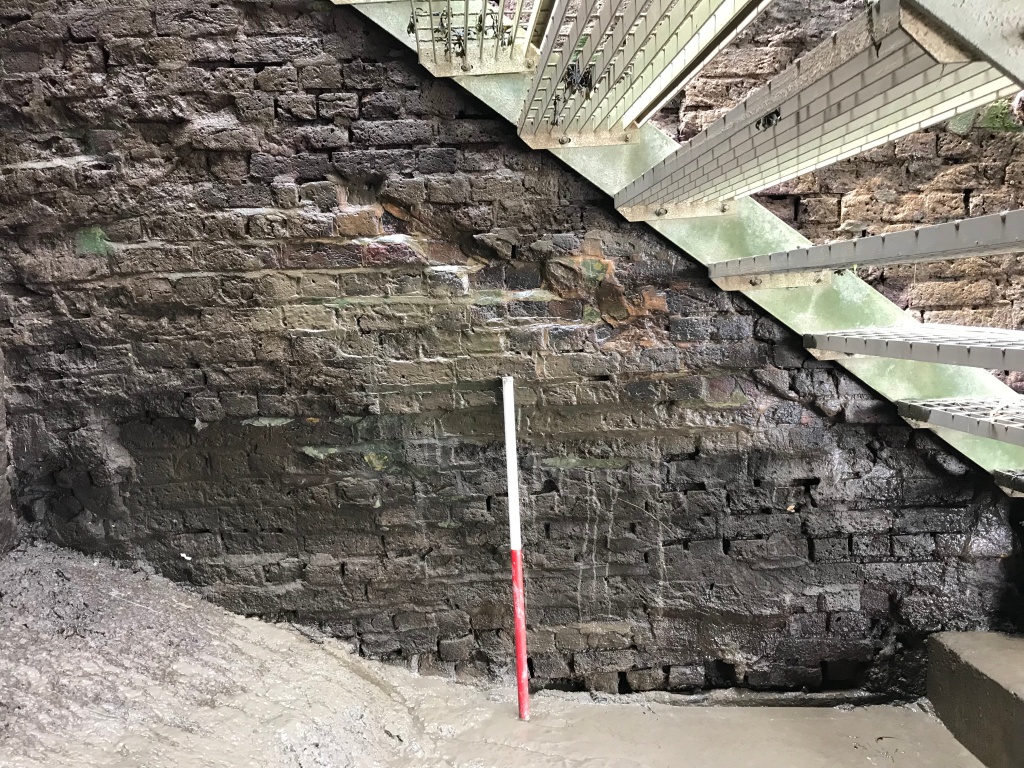
We sometimes find ghosts of previous stairs beneath the current ones. Church Stair beside the Mayflower pub, is shown on John Rocque’s map of 1746 and probably existed for at least a century before that. The ghost of a previous phase of the stair is visible in the brickwork – just above the top of the scale in the photo below. The current stair is metal but earlier phases were no doubt of wood.
At Horn Stair, in Rotherhithe (that one again) there are also traces of what may be a previous phase below the current wooden stair.

Stairs and causeways have clearly had long hard-working lives. Their remains remind us of all the people who have stood on those stairs looking at the river, or who walked along the causeways, and the many journeys they made on London’s river.
 City of London Archaeological Society
Where was Kidney Stairs? 18th century maps (Gascoyne 1703 and Rocque 1746) place it west of Limehouse Cut, about mid-Victoria Wharf, but some 19th century references seem to place it where was Stephens Stairs/Cook’s dock, east of Limehouse Cut (eg 1864 Lock improvements). Did the placename shift and if so when?
LikeLike
Hi, many thanks for contacting us. Stairs do sometimes change names and even location following riverside development. On the OS 1893 map Kidney Stairs are shown at the end of Shoulder of Mutton Alley which is to the east of the Limehouse Cut. On Rocque’s 1746 map the stairs located at the end of Shoulder of Mutton Alley are called Shipping Stairs, whereas Kidney Stairs are shown as being located to the west, as you said about mid-Victoria Wharf. We haven’t looked at this stair in detail yet but will definitely try to find out what happened. If you are a COLAS member you are very welcome to join us on the CRaFT project.
LikeLike
Hi, We think we have found the answer. In 1870, the Limehouse Board of Works dealt with complaints from the Thames Conservancy Board and from representatives of the watermen, which were caused by the unilateral removal of Kidney stairs undertaken by the Regent’s Canal company; it seems that they did not want the public crossing what was now their private property. The Regent’s Canal company decided to erect a temporary stair further east, close to the David and Harp pub which was located at 54 Narrow Street, near Shoulder of Mutton Alley (perhaps by that time the Shipping Stairs mentioned on Rocque’s map had gone). The watermen complained that the sewer, which emptied directly into the river beneath the temporary Kidney stairs, was driving away trade. The dispute seems to have dragged on for well over a year and in the end the stairs remained where they were rather than returning to their original position further west. Thank you for raising this!!
LikeLike